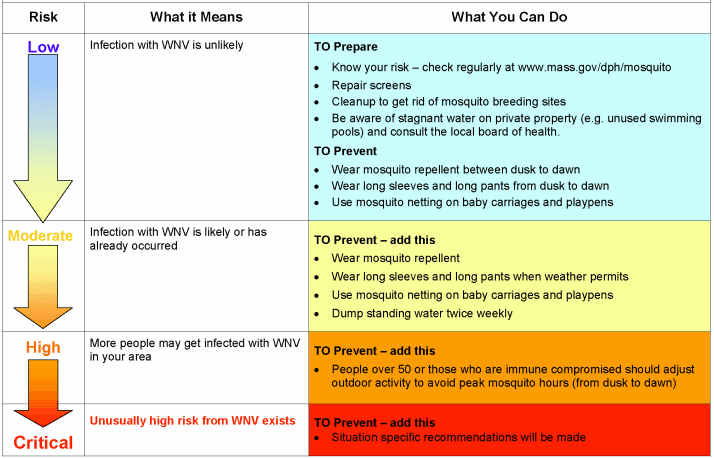
The Hingham Health Department is working closely with the Massachusetts Department of Public Health (DPH) in the surveillance of mosquito-borne diseases, including West Nile Virus (WNV) and Eastern Equine Encephalitis (EEE) in the area. Hingham’s risk level is currently low but it is advised to take precautions to prevent mosquitoes breeding and bites.
The Massachusetts Department of Public Health announced the detection of EEE in six mosquito samples in Carver (Plymouth County) and WNV in two mosquito samples in Quincy (Norfolk County).
While there continues to be a low risk in the Hingham area, the Health Department reminds residents that it is important to minimize their exposure to mosquito bites through preparation and prevention. The Hingham Health Department will be in frequent contact with DPH concerning the issue. If Hingham’s risk level should change, residents will be notified through official Town channels such as its website, Notify Me email and text subscription tool, and official notifications will go out to local media.
Residents are encouraged to utilize DPH’s EEE and WNV Risk Maps, which allow users to filter by town, types of positive cases, and samples. The Risk Maps also provide prevention instructions by risk level.
“Hingham’s risk of EEE and WNV is low at this time,” explains Teresa Flynn, RN, BSN, Hingham’s Public Health Nurse. “As a Department, we are working to educate residents on how to limit mosquito bites and breeding. If the risk should increase, we will communicate additional precautions that should be taken.”
What To Know
Mosquitoes get WNV and EEE by biting infected birds. People and animals can contract these diseases by being bitten by an infected mosquito. There is no evidence that a person will get these viruses from handling live or dead infected birds or animals. However, gloves should be worn when handling any dead animals, and double plastic bags used to discard them in the trash.
Most people bitten by mosquitoes carrying WNV will experience no symptoms or very mild symptoms and will recover on their own. Persons over 50 years of age have the highest risk of severe WNV disease.
Avoid Mosquito Bites
The Hingham Health Department offers the following tips:
- Apply insect repellent when outdoors. Use a repellent with DEET (N, N-diethyl-m- toluamide), permethrin, picaridin (KBR 3023), oil of lemon eucalyptus (p-methane 3, 8- diol [PMD]) or IR3535 according to the instructions on the product label. DEET products should not be used on infants under two months of age and should be used in concentrations of 30% or less on older children. Oil of lemon eucalyptus should not be used on children under 3 years old. Permethrin products are intended for use on items such as clothing, shoes, bed nets and camping gear, and should not be applied to skin.
- Avoid areas that tend to have a lot of mosquitoes, such as wetlands or swampy areas.
- Clothing can help reduce mosquito bites. Wearing long sleeves, long pants and socks when outdoors will help keep mosquitoes away from your skin.
- Be aware of peak mosquito hours. The hours from dusk to dawn are peak biting times for many mosquitoes. Consider rescheduling outdoor activities that occur during the evening or early morning. If you are outdoors at any time and notice mosquitoes around you, take steps to avoid being bitten by moving indoors, covering up and/or wearing repellant.
Mosquito-Proof Your Home
- Drain standing or stagnant water in and around your home or business. Mosquitoes lay their eggs in standing water. Limit the number of places around your home for mosquitoes to breed by either draining or discarding items that hold water. Check rain gutters and drains. Empty any unused flowerpots and wading pools and change water in bird baths frequently.
- Install or repair screens. Keep mosquitoes outside by having tight-fitting screens on all of your windows and doors.
- Repair leaking pipes and outdoor faucets.
- Keep your grass cut short and bushes near your house trimmed so mosquitoes can’t hide.
Anyone with questions should contact the Hingham Health Department at 781-741-1466.
Information about WNV and reports of current and historical WNV activity in Massachusetts can be found on the Massachusetts Department of Public Health website.